
DEPTH INTEGRATION
Some experiences do not resolve simply because they are understood. They continue shaping how we live until they are integrated.
Long-arc work for those operating inside complex personal and professional systems, where trauma is not a past event, but an active structure shaping decisions, relationships, and outcomes.
Work begins with a conversation.
"Rachel works at a depth I have not encountered before. She doesn't rush to solutions or techniques. Instead she helps you see the patterns shaping your life — often ones you didn't realize were there."
M., EXECUTIVE DIRECTOR
WHEN PEOPLE ARRIVE HERE
You've already done
a great deal of it.
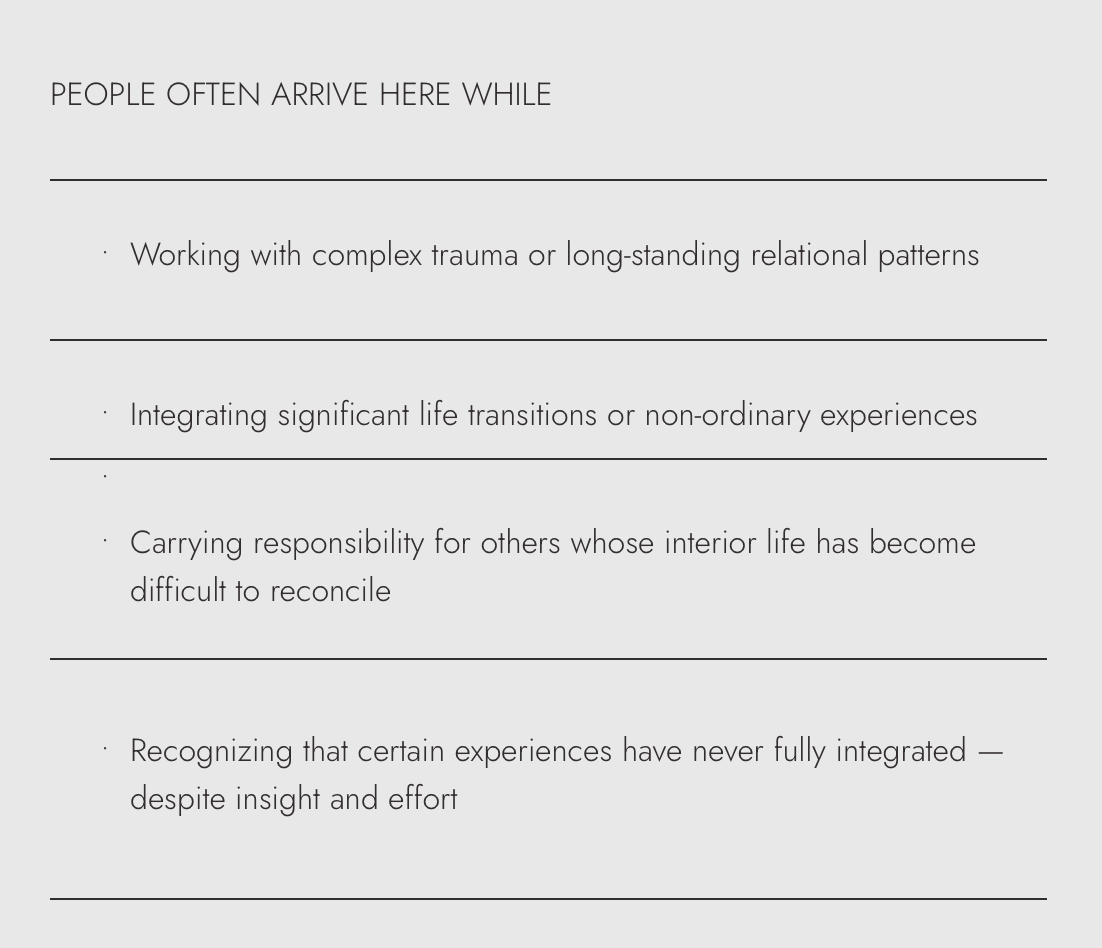
Most people who find this work are not new to personal work. Often something significant has happened — a loss, a transition, a relationship pattern, or an experience that continues shaping life long after it occurred. What brings people here is rarely singular. It is layered, persistent, and often structurally reinforced.
Not because nothing has worked— because something remains unresolved.
This work is for conditions shaped over time:
relational, developmental, or systemic
embedded in families, institutions, or leadership roles
sustained through responsibility, adaptation, or constraintThe structure adapts to the person and the material. The depth remains constant.
The aim is not simply symptom relief, but lasting structural change.
WHAT DEPTH INTEGRATION MEANS
There is a phase
beyond coping.
STAGE 01
Coping
Most people learn to cope. Coping is intelligent. It keeps us alive.
STAGE 02
Stabilization
Many learn to stabilize. Stability creates safety. Some learn to function well despite what remains unresolved.
STAGE 03 - This Work Begins Here
Integration
Helping significant experiences become part of a person’s life in a way that supports clarity, stability and desired movement.
And then there is another phase.
Not at the beginning. Not during stabilization. But after.
When you’ve already done meaningful work—and something still doesn’t shift.
Depth Integration is not a method. It is a phase of work. One that begins when foundational trauma work is already in place.
When you can understand what happened.
When you can stay present with your experience.
When you are no longer in acute survival.
And still—your life continues to organize around the same patterns.
At this stage, the focus changes.
Not on managing symptoms.
But on working at the level where those patterns are produced.
How your life is structured, relationally, professionally, systemically, around what happened. And what it would actually take for that structure to reorganize.
Depth Integration is a form of structural trauma work focused on the reorganization of patterns across a person’s life—relationally, professionally, and systemically—after foundational trauma work has already been done.
This work begins there.
"Working with Rachel is not typical coaching. It's more like having someone walk beside you while you understand the deeper architecture of your life. It's honest, sometimes confronting, and incredibly clarifying."
J., VETERAN
"I came to Rachel during a very destabilizing transition in my life. What stood out was her steadiness. She has a rare ability to stay with complexity without reducing it to simple advice."
A., PHYSICIAN
THE DEEPER WORK
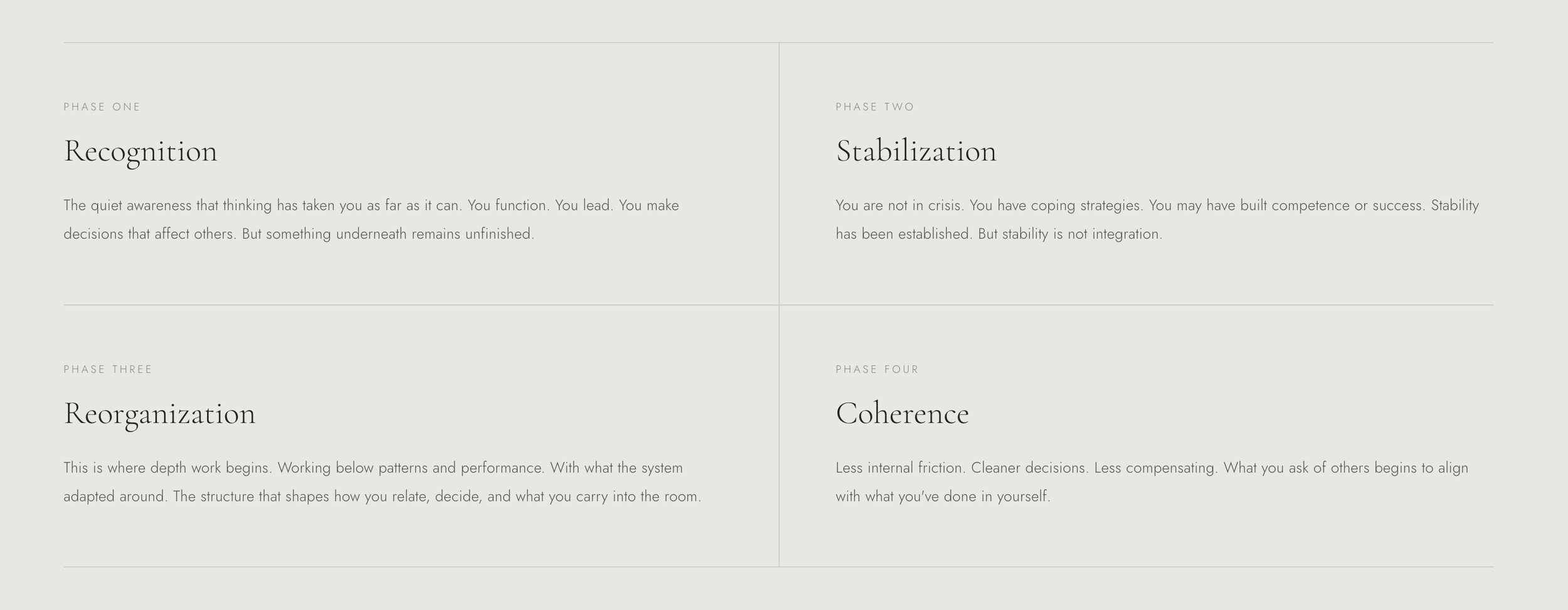
Depth work typically unfolds in phases.
Most people arrive somewhere between Phase Two and Phase Three. They have insight.
They can name their patterns. And yet the underlying structure remains.
It's not about optimization. It's not about performance strategies. We work on structural change.
"If you're looking for quick answers, Rachel may not be the right fit. If you're looking for depth, honesty, she is exceptional."
H, RETIRED PSYCHIATRIST
WHY THE WORK UNFOLDS OVER TIME
Structural change
cannot be rushed.
When long-standing adaptations begin to shift, continuity matters.
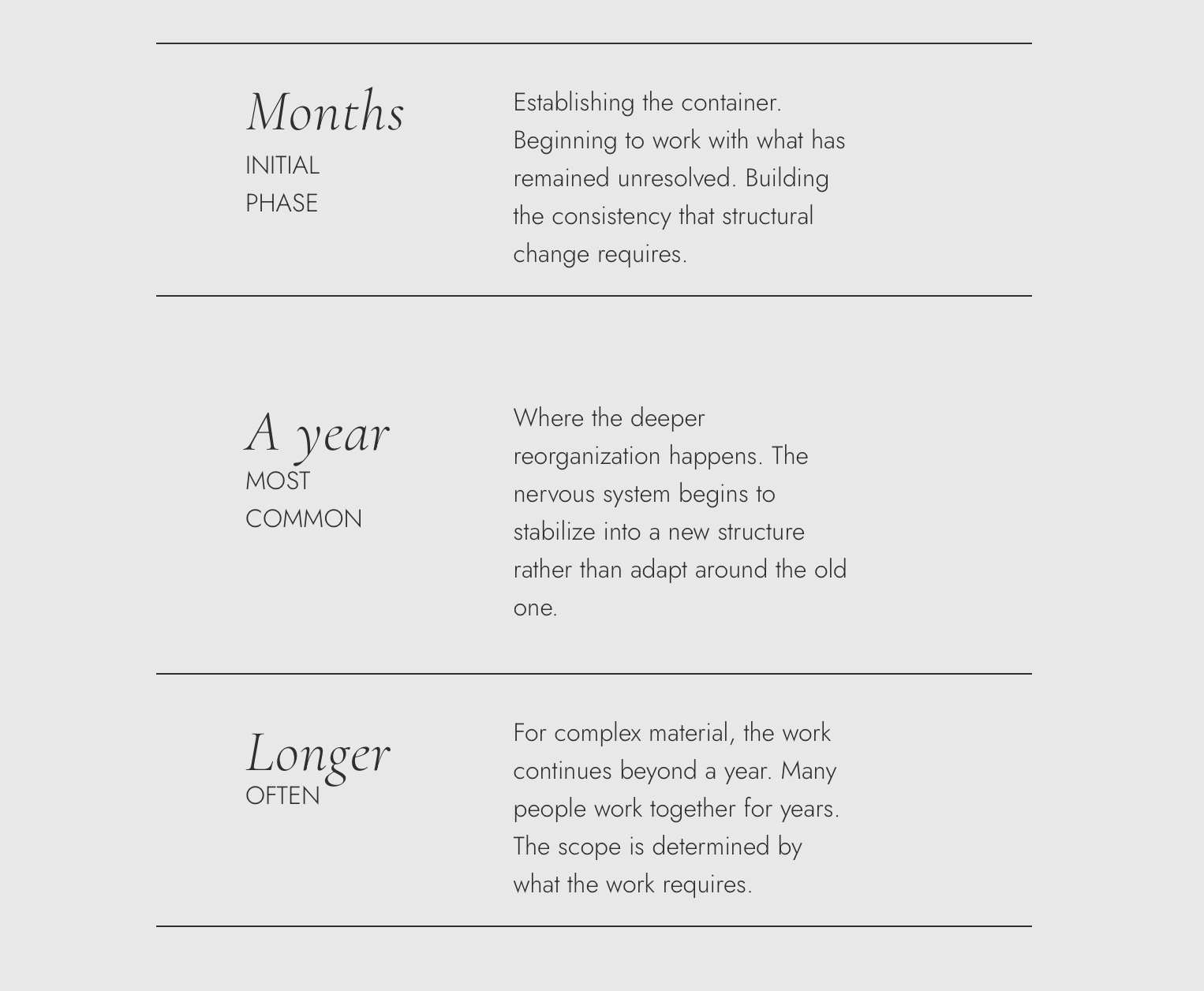
The nervous system takes time to reorganize into a new structure — rather than perform the understanding of one.
Depth-oriented work therefore unfolds over time.
Sometimes this means months.
Often a year.
Sometimes longer.
The duration is determined by the depth of the work involved, not a preset timeline.
When the timing is right, the next step is a conversation.
HOW THE WORK BEGINS
All work begins with a consultation.
Consultations are 60 minutes. We will discuss where you are now, what has shaped you, and where your life may be moving.
The purpose is not intake — it is to determine whether this work is appropriate, and whether I am the right person to hold it. If we both sense alignment, we will discuss what the work might look like. If not, I will say so clearly.
If you are in acute crisis or seeking short-term intervention, a different form of support may be more appropriate. I can help point you in the right direction.
During the consultation, we will explore where you are now, what feels unresolved, what is changing, and what you are building toward.
THIS WORK IS BEST SUITED FOR THOSE WHO:
• Have already done meaningful personal or therapeutic work
• Are stable enough for depth-oriented exploration
• Are ready for structural change rather than incremental adjustment
• Can commit to continuity
• Are willing to stay with material as it unfolds, rather than move toward resolution prematurely
THE WORK
Two ways the work
may unfold.
After a consultation, if there is alignment, the work takes one of two primary forms — or occasionally both, depending on what you are navigating.
Depth Integration
Session
Sessions are 90 minutes, held in person or remotely.
The work begins weekly. For most people, the first six months build safety and trust, establish context, and allow the material to surface at its own pace. At six months, we review together. Some continue weekly. Others move to biweekly. The cadence follows the work.
There is no fixed protocol. Sessions are structured around what is present — not a program to move through. What remains consistent is the depth of attention and the continuity of the relationship over time.
Psychedelic Preparation, Facilitation, or Integration
Psychedelic experiences can bring forward meaningful psychological and emotional material. Approached carefully, they can open territory that other work has not reached. Approached without preparation or integration, that material can remain unprocessed — or become its own source of complexity.
This work supports all three phases: preparation before an experience, facilitation within Oregon's regulated psilocybin services, and integration of what emerges afterward.
Available in Oregon. Integration work is available in some cases internationally.
"Rachel has a rare ability to combine emotional intelligence with structural thinking. She helped me see how my nervous system, my leadership role, and my life history were all interacting."
S., CEO
"Rachel's work helped me understand how past experiences were still shaping my decisions and leadership style. That insight has been invaluable."
P., EXECUTIVE DIRECTOR
ABOUT RACHEL
I am a complex trauma practitioner. I know this territory from the inside. My early life included the kinds of experiences that don't get named clearly in most professional biographies — abuse, neglect, loss, and cult life. I didn't have language for any of it then. I didn't need language — I needed to survive.
The following twenty-five years became something else: the slow, nonlinear work of integration. Not recovery in the way that word is usually meant. Something more structural than that — learning what it actually takes for the nervous system to reorganize, for patterns formed in survival to loosen their authority over a life being built in different conditions.
That path is not separate from this work. It is the foundation of it.
Alongside that interior work, I have spent more than two decades as a practitioner and entrepreneur across wellness, health, beauty, ritual medicine, and emerging therapeutic fields. I co-founded and led organizations in regulated environments — including Synthesis Institute and InnerTrek Service Center — designed training and facilitation programs, conducted academic research, and supported more than a thousand people through psychedelic experiences in licensed and non-licensed settings.
Many, though not all, of the people who find this work are themselves practitioners — therapists, physicians, facilitators, founders, and others who carry responsibility for others. They have often completed substantial personal work already, and recognize that some things do not shift through insight alone.
My work is informed by training across multiple integrative traditions, including somatic and nervous-system-based approaches, contemplative practice, creative and expressive modalities, and nature-based frameworks. I hold a B.A. in Transformative Education and Leadership and an M.A. in Clinical Mental Health Counseling with a focus on Trauma-Informed and Responsive practice, and am completing a Ph.D. in Integral and Transpersonal Psychology, where my research examines psilocybin-assisted treatment for complex trauma.
I write about complex trauma, depth work, and integration at rachelaidan.substack.com.

"Rachel does not promise quick transformation. What she offers instead is real understanding and long-term integration."
C., THERAPIST
"Rachel created a space where total honesty feels possible. I was able to talk about things I had never spoken about before."
N., ATTORNEY
-
Depth Integration is not psychotherapy and it is not conventional coaching.
The work draws from multiple disciplines — trauma-informed practice, depth psychology, relational work, and integration frameworks — but it is not treatment for a mental health diagnosis.
The focus is structural integration: helping significant experiences become part of a person’s life in a way that supports clarity, stability, and forward movement.
-
Most people who reach out have already done meaningful personal or therapeutic work.
They have insight into their history and patterns.
What brings them here is the recognition that something deeper remains unresolved despite insight and effort.
They are generally stable in their lives, able to reflect on their own experience, and willing to stay with material as it unfolds rather than looking for quick solutions.
Many are integrating significant experiences or long-standing relational patterns. Others carry complex responsibility in their professional or personal lives.
People who find this work include veterans, leaders, clinicians, therapists, psychiatrists, facilitators, and others who spend their lives holding complexity for others.
The consultation allows us to explore whether depth integration work would be useful for you.
-
Most people begin with one year, and we review ongoing work from there.
Many people work with me for years, not months.
The length of our working relationship and frequency of meetings depends on the individual’s needs and other personal factors.
During our consultation, we take our time to consider all of your needs in order to make the best decision.
-
Psychedelic work is addressed through a consultation. If you are seeking a session in Oregon, there is a very specific process.
preparation, facilitation, and integration are available
services follow Oregon Psilocybin Services regulations
this is separate from general integration work
Session work outside of Oregon or the U.S. can be addressed in our consultation.
-
This practice is not designed for acute crisis intervention.
If you are currently experiencing a mental health emergency or require immediate support, please consult a licensed mental health or medical professional.
-
Yes. Many people in this work are leaders, practitioners, or others who hold significant responsibility. The decisions you make affect other people — and that weight has its own interior cost. This work takes that seriously.
-
The consultation is designed in part to assess fit.
If depth integration work does not seem appropriate for your situation, I will say so directly. In some cases, another form of support may be more useful, and I will do my best to point you in the right direction.
Not every kind of work is right for every situation, and clarity at the beginning is important. The consultation is a genuine conversation — not a sales process.